Come join us and see what we are about.
General membership meetings are open to all state employees and their allies. Meetings are currently held via Zoom from 9am to 11am on the second Thursday of every month.
Sign up here to receive our Govdelivery
meeting notices and event updates!
DIN can now take attendance for their meetings with a QR code.
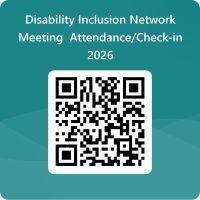
Using your smartphone, you can scan the QR code above and sign in before the meeting.
You can also use the link below this sentence to go directly to the attendance check-in page:
Disability Inclusion Network Meeting Attendance/Check-in 2026
ASL First Meeting Information
ASL First meetings are for state employees who identify as Deaf, deaf, DeafBlind or hard of hearing. These meetings are a space to share experiences, information and resources.
ASL First usually will have an "Open House" once a year in which we invite other people to join us to learn how to best work with fellow Deaf, deaf, DeafBlind and hard of hearing employees.
If you have questions about these meetings or would like to share something with the ASL First group, please email elizabeth.luttrell@dshs.wa.gov to be added to the agenda.
We invite any ASL First member to take a turn facilitating a meeting or to suggest a topic for discussion.
ASL First meetings take place from 12:00-1:00 PM on
February 11
April 8
June 10
August 12
October 14
December 9
Global Accessibility Awareness Day (GAAD)
Help us celebrate the 15th Global Accessibility Awareness Day (GAAD) on May 21, 2026. The purpose of GAAD is to get everyone talking, thinking and learning about digital access and inclusion, and the more than one billion people with disabilities/impairments. To learn more, including how to attend a free accessibility training, visit the GAAD website.
June 2026 PRIDE Month Events
Help celebrate LGBTQ+ Pride month by attending an event in your neighborhood or area. To learn more, visit the Washington State LGBTQ+ Events Calendar website.
2026 Disability Pride Month
Disability Pride Month occurs each July to coincide with the anniversary of the signing by President George H.W. Bush of the Americans with Disabilities Act on July 26, 1990, which protects the rights of people with disabilities and ensures their inclusion in American society.
According to the National Center on Birth Defects and Developmental Disabilities, as of 2024, 70+ million (28.7%) of American adults are living with a disability.
This event, which occurs in many nations around the world, celebrates people with disabilities, their culture, their strength, their resilience, and their contributions to society. It seeks to change how people define disability to combat ableism, advocate for disability rights, and promote the belief that disability is a natural part of life by challenging stereotypes. Nearly everyone either knows someone who is disabled, or at some point will themselves become disabled, even if temporarily, due to an illness or injury.
Event Links
Disability Pride Month 2026: Celebrating Inclusion Across Oregon and Southwest Washington
Whatcom County First Annual Inclusion Festival
Spokane Bridging Communities Celebration
King County/Seattle Disability Pride Flag Raising Ceremony
Check back here as we add links to more events celebrating Disability Pride Month in the Pacific Northwest!
Select or click on the image below to download this Teams background:
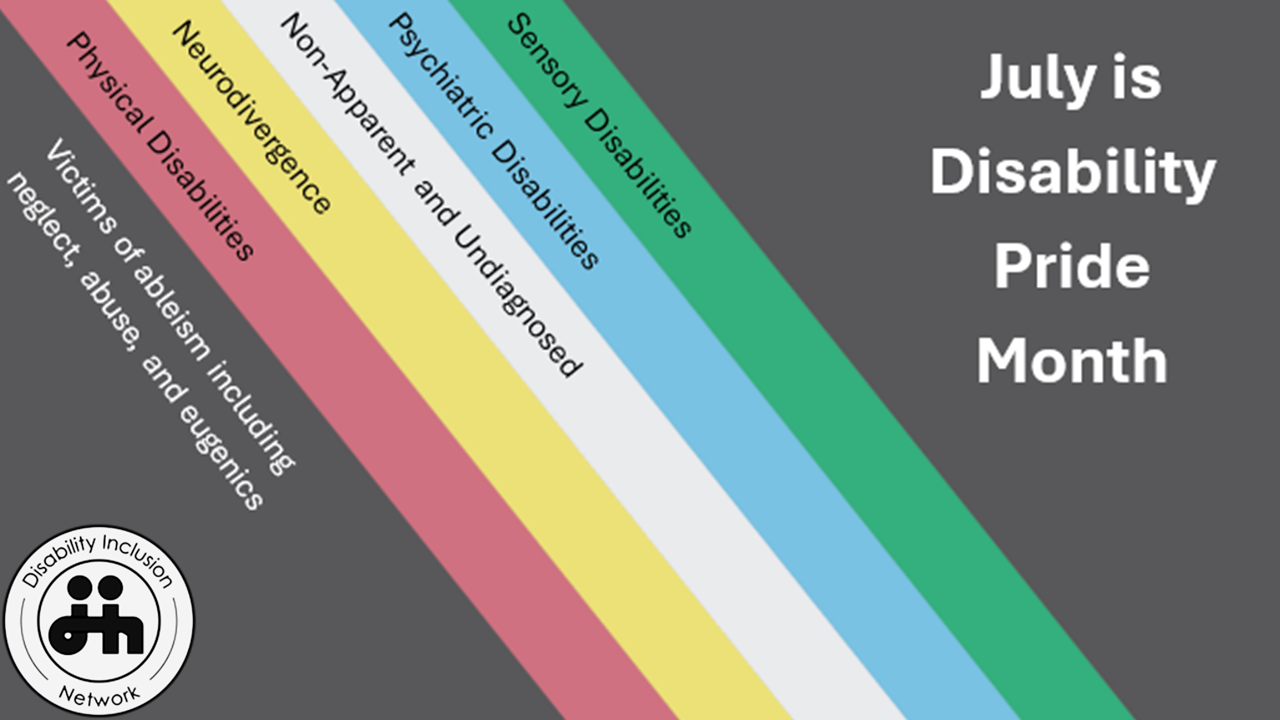
July is Disability Pride Month and the anniversary of the signing of the Americans with Disabilities Act
About The Disability Pride Flag
- Created by Ann Magill, a disabled woman, in 2019.
- Redesigned in 2021 based on feedback to be more accessible.
- Redesign was a collaboration on Tumblr App/website.
- The areas and colors on the flag each have a meaning.
The Black Field (top right and bottom left corners) - represents disabled people who have lost their lives to illness, negligence, suicide, eugenics.
The Diagonal Stripes Between the Black Fields: (running diagonally from top left to bottom right corner)
Green Stripe – represents sensory perception disabilities.
Blue stripe – represents mental health disabilities.
White stripe – represents non-apparent and undiagnosed disabilities.
Yellow stripe – represents cognitive and intellectual disabilities.
Red stripe – represents physical disabilities.

October is Disability Employment Awareness Month
From the Governor's Committee on Disability Issues & Employment (GCDE) staff
Every October, organizations across the United States observe National Disability Employment Awareness Month (NDEAM) to recognize the contributions of workers with disabilities and reaffirm commitment to building inclusive workplaces where everyone can thrive.
In Washington state, disabled workers contributions to the workforce are recognized and supported through:
Our modern civil rights have roots stretching back more than 75 years, shaped by advocacy, legislation and the leadership of workers with disabilities. Congress declared the first week of October “National Employ the Physically Handicapped Week.”
When many World War II veterans returned with newly acquired disabilities, the nation faced a responsibility to support their reintegration into civilian life. The declaration emphasized ability, urging employers to reconsider outdated assumptions about workers with disabilities.
This was the first time the federal government formally recognized Americans with disabilities as a vital part of the workforce.
The 1960’s and 1970’s
Disability advocacy continued to evolve when leaders pushed for recognition of all disabilities, including intellectual, developmental, sensory and mental health disabilities. The self-advocacy and independent living movements grew and recognized that disability is not a medical issue but rather one of civil rights and acknowledged that employment barriers are environmental and attitudinal. As a result, workers with disabilities became more visible in public service and other sectors.
1988
Congress expanded the NDEAM week into a full month and renamed it National Disability Employment Awareness Month. NDEAM is coordinated by the U.S. Department of Labor’s Office of Disability Employment Policy (ODEP). Each year, ODEP selects a theme emphasizing that disability inclusion is not charity or compliance — it’s a driver of innovation, diversity, and organizational strength.
1990
The passage of the Americans with Disabilities Act (ADA) transformed the civil rights of people with disabilities.
The ADA prohibits discrimination, requires reasonable accommodation, and affirms people with disabilities’ civil rights in employment. NDEAM became a platform to highlight ADA implementation, workplace accessibility, and the importance of inclusive hiring practices.
Why NDEAM matters for us today
NDEAM reminds us that:
- People with disabilities are part of every profession, every department and every community.
- Accessibility is an ongoing practice, not a one‑time project.
- Inclusive workplaces benefit everyone. They improve retention, morale and organizational resilience.
- Employment is a key pathway to independence, community participation and economic stability.
It’s also a reminder to celebrate the leadership, expertise and contributions of colleagues with disabilities who strengthen our work every day.
How we can celebrate NDEAM this year
Here are meaningful ways teams can participate:
- Highlight voices with disabilities and learn from those with lived experience. Attend a DINBRG meeting or an EMPOWERED ERG meeting.
- Share resources created by the Governor’s Committee on Disability Issues & Employment (GCDE) and the DINBRG.
- Host a discussion on disability inclusion and workplace culture.
Closing message from the GCDE staff:
- Inclusion is an everyday practice which is reflected in ESD’s shared values.
- Reaffirm our commitment to building a workplace where employees with disabilities are welcomed, supported, and valued — not just in October, but every day.
Inclusion is a shared responsibility, and together we can continue shaping a culture where everyone has the opportunity to succeed.
A DIN Lunch and Learn presentation by the DIN subcommittees was held October 19, 2022. We discussed workplace strategies that foster inclusion of people with disabilities in all aspects of employment .